
Llama FAQ
The following article by Paige McGrath was written in 1996. However, as I re-read it this morning from a perspective of 15 years raising llamas I have to admit that when I first read the article I did not appreciate the wisdom and experience that Paige had wrapped up in this short set of guidelines. Thank you Paige.
About the Author
Paige McGrath has bred llamas at Lower Sherwood Farm in Charlottesville, VA since 1986. She is the publisher of Llama Life II, and contributes to the lama show world by providing the Virginia Classic Llama and Alpaca Show each spring. Email Paige or visit her website for more info!
Originally published in Llama Life II, Fall 1996 - Issue #39
We relinquish copyright protection on the following for the purpose of allowing those, who do not have their own written standards and who sell to those who have little understanding of camelid care, a comparatively concise outline that may be reproduced and distributed or given to new owners. The byline may be removed and additions, modifications and alterations to suit individual circumstances may be made.
1. Don’t buy babies younger than 4 or 5 months
Unweaned crias (baby llamas) are not suitable pets. If you have inadvertently obtained one, bottle feed it 20 percent of its weight daily with plain homogenized Vitamin D milk (reinforced with nutrients if it doesn’t gain daily) and don’t cuddle it. Offer it a coarse sweet feed and free choice quality hay at an early age. It will start to nibble when it is ready. Naturally raised crias, not normally weaned until six months, should gain a half to a full pound daily. Provide it with another animal for company - preferably a llama - but keep physical human contact to a minimum. An adult llama bonded to a human from near-birth without proper herd socialization can be a danger when the animal treats the human as another llama. Seek information from knowledgeable reputable breeders or veterinarians. A reputable breeder will not sell you a cria under four or five months of age.
2. Llamas left haltered are in peril
Because many owners don’t train their animals to haltering, or provide a catch pen or stall for doing so, they leave the halters on all the time. This results in abscesses, ulcers, unsightly calluses….and, if the halter is caught on something, a broken neck. And because haltering has not been mastered, some owners leave the SAME halter on a growing animal. Some have been found with the flesh growing around the noseband or with malformation of the nasal passages.
Continue Reading »
Llamas are in general are easy to keep, and are healthy, hardy, disease-resistant animals. They do best with routine medical attention and some common sense attentiveness from their owners. This information is not intended to be all inclusive, but new owners should find the material useful in determining good health care for their llamas. In all cases, advice and assistance from your veterinarian is recommended.
A llama’s gestation period is 11 1/2 months (350 days), with variations of plus or minus 2 weeks not uncommon. Normal labor generally lasts about 2 hours, with the baby presented front feet first, followed by the nose, head, body and rear legs. Dystocias (difficult births) are seen, but are not common. The mother usually delivers the baby from a standing position, where gravity will assist in delivery.When the baby, called a cria, is born, it is not surrounded by a sack. It is wet and covered with a membrane that may need to be cleared from the nose and mouth to allow breathing. The mother will not lick the baby dry. Normal crias, supported on legs that are still wobbly, will be up and nursing within an hour or so after birth. The attentive owner will make sure the mother has delivered a complete placenta within an hour or two after birth. Dipping the cria’s navel in mild iodine or Novasan is recommended to prevent infection. Normal birth weights are from 18 to 35 pounds, and the breeder will monitor nursing and weight gain daily. A cria often looses as much as a pound of weight the first day, and then should steadily gain 1/2 to 1 1/2 pounds a day thereafter. Routine IgG levels can also be run to ascertain adequate immunity through passive transfer.
Female llamas are induced ovulators, meaning that release of a mature ovum for fertilization is induced by copulation. They do not have an estrus, or heat, cycle. Llamas can be breed any time of year, although breeders prefer to avoid births occurring during the extreme heat and humidity of summer, or during the severe winter months.When the male llama approaches an open female, she may initially resist his advances, but then she will lie down in a kushed position for him to mount her.Actually breeding can last from 5 minutes to over an hour, with 20 minutes about typical. The male will release semen slowly during the course of the breeding. Approximately 7 days after successful impregnation, the female will resist the advances of the male, often to the point of “spitting-off.” Occasionally open females will spit-off a male, and pregnant females may lie down and allow the male to mate. Due to this variability, behavior is not always a conclusive indicator of pregnancy. Breeders can take advantage of progesterone level testing and ultrasounds to reliably determine pregnancy or the source of breeding problems.
Llamas do well on grass pasture, although a fescue grass may contain an endophyte that can contribute to abortions and should be avoided if possible. Good quality grass hay can supplement pasture, and be used for the bulk of winter feeding. The hay should be ideally 10% to 12% protein of maintenance of adult llamas. Alfalfa in large quantities should be avoided; it generally has too high a protein content, can contribute to obesity, cause urine scald, and can upset the calcium/phosphorous balance in the blood.Most breeders provide a llama supplement, or llama chow, containing vitamins and minerals. This is usually given at the rate of about one pound per day per llama. Several commercial mixtures are available, and can usually be obtained from your local feed mill.
Loose salt is also provided free choice. Commercial mixes and salt blocks designed for other livestock are not formulated for llamas; they may contain minerals and contaminants not appropriate and even harmful to llamas. For example, your locale may be deficient in selenium. However, too much selenium is also harmful. Consult with your veterinarian on a source of salt designed for llamas in your area.
Most common is the four foot high woven wire cattle fence. While adequate in many situations, this fencing is not impenetrable to predators, who can dig under or climb/jump over the fence. Llamas can also jump a four to five foot tall fence, although they usually won’t unless being pursued, or while trying to reach a companion, or even just to get to better grazing (the grass is always greener….) An electric wire run low to the ground around the outside can help in preventing dogs from digging under the fence. Stud males may required more substantial or taller fencing, as they are more tempted to jump to reach females or “climb” the fence to display to other males.New-Zealand style high-tensile fencing is an economical, attractive, long-lasting fence. However, it needs to be electrified to resist predators. If a llama reaches through or tries to jump the electric wire and becomes entangled, death will almost certainly result from disruption of the electrical path in the heart. Therefore, use of this type of fencing should be carefully considered.
Special care should be taken when separating mothers from their babies during weaning. The baby may do everything within its power to jump, crawl around, under, or through any fencing to return to its mother, with potentially deadly results.
Remember that no fence is completely predator-proof; as can be sadly attested to by many llama owners who have lost llamas to roaming dogs, and even neighbor’s pet dogs.
The fighting teeth are very sharp, dagger-like teeth, on the upper and lower jaw, developed by the male llama upon maturity. They are dangerous to all those around him, including humans. Both geldings and intact males will develop these teeth. They need to be removed at the gum line, which can be done by your veterinarian quite quickly using OB wire. The teeth may in time grow back, and the procedure needs to be repeated, so they should be checked for regrowth periodically. Occasionally, females will develop a significant set of fighting teeth that also should be cut, although this is not as common.
Male Ilamas have sharp-edged fighting teeth which may begin to erupt by two years of age. These teeth are along the side of the jaws about halfway back. There are two on the upper jaw and one on the lower jaw on each side of the mouth. Fighting teeth have very sharp points and cutting edges front and back and are curved like a crooked finger. Some Ilama owners choose to have tooth cut by their vet, but many feel that the procedure is simple enough to be considered a routine part of their herd management.
Cutting Fighting Teeth
The most commonly used technique for removal of fighting teeth is to cut them off at the gumline using a flexible braided cutting wire known as obstetrical or OB wire, available from your veterinarian and livestock supply stores. Special metal handles are available for gripping the ends of the OB wire, and if these are used a 24″ length of wire is adequate.

Restrain the animal in a chute. A large diameter lead rope can be inserted across the lower jaw to help to keep the mouth open while cutting the teeth.
Carefully retract the lips on one side and hook the wire behind the forward upper fang. The fighting teeth are slightly curved backward, so the wire will find its proper position at the gum line as you pull the ends of the wire forward. The OB wire is designed to cut only hard tissues like bone or tooth without cutting soft tissue, so once the wire is in place the animal may be allowed to close his lips around it.
Both ends of the wire should be directed forward out of the mouth, one end held in each hand. Draw the wire across the tooth by pulling first with one hand and then the other at a rate of about one stroke per second while maintaining a firm pull on the wire. Usually the fang will be cut off neatly at the gumline in about 15-20 seconds. There may be a little bleeding from abrasion of the gums, but this is no problem. Any sharp edges or points which remain can be smoothed with an ordinary metal file. Make sure that the sharp, severed crown of the tooth is out of the animal’s mouth before going on to the single lower fang on the same side, and then the rear upper fang. Repeat the process on the opposite side. After one use the wire will coil when tension is released. This makes placement on subsequent teeth a bit more difficult, but the same piece of wire can be used on all six teeth and even reused on additional animals if disinfected in Betadine solution prior to re-use.
Fighting teeth can be cut off as soon as they have erupted even 1/4″ and this is sound management policy. The teeth will continue to erupt until the animal is 4-5 years old, so put a reminder in your files to check the teeth of your males every 6 months and redo the procedure if necessary. Female Ilamas can get small fighting teeth. These erupt much later and usually are not removed.
Llamas benefit from regular, short grooming sessions to remove debris and dead wool. If wool is allowed to matte, air circulation is hindered, and the llama is more susceptible to heat stress. This is true of short and long wooled llamas, although the long-wooled varieties will naturally have more of a problem. Regular sessions desensitize and train your llama, and also make it better prepared for final grooming required for show preparation. Long sessions of monotonous, often painful hair-pulling should be avoided. Start grooming your llama well before show season, and keep it reasonably groomed with regular attention.
There are probably as many different grooming tools and preparations as there are llama owners. The types of tools you will need to groom your llama will depend on the character of your llamas wool. A good source of grooming supplies is Quality Llama Products
Heat stress claims the lives of many llamas every year. Proper grooming, including shearing, is required especially of long-wooled llamas. Shade and ventilation, including the use of fans to circulate air around the llamas can prevent the occurance of heat stress in all but extreme conditions. When the temperature and/or humidity are high, llamas should not be stressed, which can include transporting, showing, herding/running the animals, packing, or breeding. They should have access to shade, air flow, and fresh, cool water. Some breeders add electrolytes to the water source.Pools of water such as kids plastic wading pools are sometimes used by the llamas, as are natural ponds and streams. Wetting down a sand pile in a shady area can provide a cool place for llamas. Hosing down the llamas legs and under the belly can help. However, be careful not to wet the llamas body wool, as this will create an insulating wet blanket and make the heat rejection more difficult.
Symptoms of heat stress include high respiration rate, open-mouth panting, foaming at the mouth, staggering or walking stiff-legged, inability to rise, and collapse. A rectal temperature over 102 degf for an adult is indicative of heat stress. Animals exhibiting symptoms should be treated immediately to bring down the temperature.
Complete shearing, wetting, soaking in cold cloths, ice or alcohol packs applied under the belly and to the back of the head can help bring down internal temperatures. A cooling enema can also help. A collapsed animal is in critical condition, and your vet should be consulted immediately. Complete recovery from severe heat stress can takes weeks, or longer; if the patient survives.
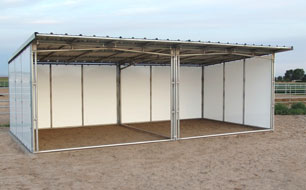
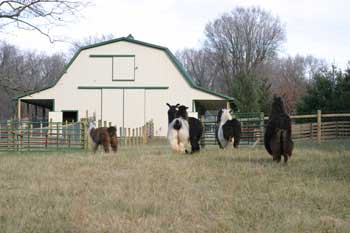
Housing for llamas can be simple sheds to elaborate barns. The basic winter requirements are shelter from inclement weather (rain, snow) and wind protection, which can be provided by as little as a three-sided shelter with the open side facing away from the prevailing wind. More substantial shelter may be required during severe (below zero degrees Fahrenheit or colder) or prolonged cold spells. Supplemental heat is rarely required for healthy adult llamas in US climates, although a thick bed of straw will add considerably to the llamas’ heat retention capabilities.While the simple shelter is necessary to protect from rain, the added danger of summer heat requires a source of shade in a well-ventilated area. Shearing of the llamas’ wool, the use of fans, and small ponds of cooling water (such as kids’ plastic wading pools) can be invaluable in reducing the risk of heat stress. In most US climates, the danger of heat stress in summer is far greater than danger from cold conditions in the winter.
The two toenails on a llama’s feet need to be kept trimmed flush with the bottom of the foot. Rate of growth varies, and the nail can be worn down naturally if the llama walks on hard surfaces regularly. Some breeders install a concrete pad near waterers, feeders, or barn entrances to wear the nails, and reduce the frequency of trimming. Trimming may be needed anywhere from monthly to annually, depending on conditions. Trimmers made for this purpose are the best choice, and a well-trained llama who has had his legs and feet desensitized can make the chore easy. The use of a llama chute or other restraint is helpful for untrained llamas.
A newborn needs to take of mother’s first milk soon after birth. This thick colostrum contains important immune antibodies from the mother that can only be absorbed through the cria’s stomach during the first 24 hours after birth. If sufficient absorption has not occurred, the cria’s immunity is compromised, with potentially fatal results.In cases where the cria will not–or cannot–nurse, llama, goat, or cow colostrum can be given during the first 24 hours. An IgG level can be taken by drawing a blood sample to determine the extent of passive transfer. Llama plasma transfers can be done after the first 24 hours to improve immunity. Breeders should consult with their veterinarians for assistance in feeding, IgG’s, and plasma transfers. Further information on IgG’s and plasma transfers, as well as hyper-immune llama plasma is available from Triple J Farms: Plasma, IgG Testing IgG testing can be done by M&M Veterinary Laboratory.
We feel that breeders should remove stock from the gene pool that have a genetic predisposition to birthing, milking, or immunity transfer problems. New owners, in particular, should ask questions and be waryof animals sold with little or no known previous medical history.
The following article written by Jenny Deters was written several years ago when there was an active llama wool pool in Indiana. The wool pool no longer exists, but these guidelines are still valuable to those preparing your own fiber to be sent to a mill.
About the Author
Jenny Deters has bred llamas at Deter’s Hickory Hollow Llamas in Evansville, IN since 1988. She has been active with fiber arts and spinning for several years, creating many handmade items from luxury fibers such as llama. She established and operated the Midwest Wool Pool from 1997 to 1999, holding fiber seminars and training others to carry on the wool pool’s fine tradition. She is also a certified ALSA fleece judge.
I am not going to start exactly from the beginning on getting your fleeces ready for shipment to the wool pool, but I will say that the cleaner you keep your llamas through the winter, by good pasture management and feeding practices, the less work you will need to do in grooming your llamas before shearing. I will explain how we prepare our llamas at shearing time.
We use a chute, because we’ll also trim nails and do routine wormings at this time. Since most of our llamas have been sheared before, in one style or another, the blanket area is easy to groom, with a quick once over with the brush and then the blower to remove a majority of the dust. For those who haven’t been sheared, we’ll blow first, to hopefully remove some of the debris, then we’ll brush (two of us - one on each side) for a few minutes, then use the blower to get out the loose debris. If you simply can’t remove most of the debris this way, then the fleece may be too dirty to consider for the pool. (We do not expect perfectly clean fleeces, but the mill can’t process out all the debris and we do want yarns that can sell.) I’d like to add here, that we shear all our llamas, including the spring babies. Yep; even 2-3 months old.To shear, we use small electric clippers. We did use scissors for several years, but with a large number of llamas to shear, the electric clippers are faster. Some people use sheep shears - although we did have the large ones, we feel the chute to be too close quarters for the shears to be safe from cutting the llama, so we sold ours (we used to have angora goats.) Use whatever is comfortable.If on concrete, make sure the area is swept and clean. If on dirt, gravel, sand or whatever, put down a tarp or make sure the fleece doesn’t touch the ground. Keep the fleece clean. Sort out as you go by either shearing and removing the blanket area first (this is the best fiber) or shirt off the belly fiber as you go. The belly fiber is courser than the blanket - it is scratchy and definitely not sweater quality - don’t send this to the pool. As for the neck and leg portions, it depends on the llama as to the quality, so put this is a separate bag if you decide to send it, but remember it needs to be over 3″ long.
Fleeces that will not be accepted are: Fiber that is matted and can’t be easily pulled apart, fiber too short - the down, which are the finer hairs, needs to be at least 3″ long, fiber too long - do not send anything over 10″, preference is 6″, and fiber that contains rocks, pine cones, burrs, lice, moths or mold - don’t send.
Also for the ‘99 shipment we ask that each of your fleeces be packaged separately. This can also be done by putting each fleece in its own plastic bag. (Please make sure the fleeces are dry before shipping or they will mold, therefore becoming worthless.) The length is very important, because if it is too long, say over 10″, the fiber will damage the mill’s equipment and if it is too short, the fiber will clump on the drums, keeping the yarns from being smooth and consistent.
We all want high quality yarns, but for the most part, it is the guard hair that keeps it from being the high quality. If you want to spend the time to get the high quality, you can pull out the guard hairs by hand (as of now, there aren’t any mills in the U.S. that can dehair our small amounts at a reasonable rate.) Our blends did improve the quality of the yarns, but the biggest drawback is the cost of these fine fibers. Eveyone seemed quite happy with the blends, so we will probably purchase them again in the ‘99 pool.
What the future of our pool holds, we don’t know. Frankly, it is up to you. You could have items made with the fiber such as blankets, fabric, scarves, comforters, etc. But keep in mind, at this point we are only volunteers and we’d need to hire someone to handle the financial aspects of this type of endeavor. Our goal is to combine with the other pools in the U.S. to increase our poundage, someday tonage and we hope for an eventual Co-op, where our fiber can be sold. It all takes time, patience, and participation, but we’ve got to start somewhere. Be part of that start!
Llamas should be sheared of their burden of wool for the summer months. A complete shearing, head to toe, on longer-wooled llamas, especially those that have developed matted wool due to lack of regular grooming, can be a heaven-sent gift to your llama! Other shearing styles are popular that do not remove as much wool. Belly, or barrel cuts, with attention paid to opening up “breathing space” in the arm pits, in front of the rear legs, and under the tail, are often used on show llamas.

It is dangerous to leave a llama unsheared, or to not shear enough wool to provide adequate cooling just to make the llama more attractive at a show. In the past several years, the majority of llamas participating in shows in the warmer season are shorn.
Any animal developing heat stress symptoms that has not been sheared should be sheared immediately.
We typically shear all llamas over a year old, although we have sheared younger animals with particularly heavy wool sooner. We also shear our short-wooled llamas. Leaving about 1 inch of wool will keep the llama from sunburning. Regular sheep shears or Fiscar Scissors can be used. Shearing should be performed before hot weather starts, which will also give time to grow back a significant coat for winter protection.
Shears
Many different tools can be used to shear your llamas. If you only have a few llamas a large pair of Fiscar scissors can be used to shear your llama. Scissors give a nice mottled or contour look. If you have more than just a few llamas you may want to invest in a set of electric shears and one or more sets of extra blades (1 set for every 3 to 4 llamas). The extra blades enable you to work your way through the entire herd before you have to send your blades back to be sharpened.
Our favorite set of electric shears are the Lister Lasers (Orange). They are a little heavier than the Lister yellow handle shears but are much more powerful and enable you to get more shearings with a set of blades. We have had very good success sending our blades back to http://www.premier1supplies.com/. They have very quick turnaround and do an excellent job of returning your blades in like new condition.
I would caution against sending your expensive blades to your local sharpening service because it takes special centerless grinders to grind the correct curvature into the surface of the blades. If the blades are ground flat they can overheat and loose their temper.
As a minimum, annual vaccinations for CD&T (Clostridium C&D and tetanus) are required. Your veterinarian may recommend 7-way or 8-way vaccines, depending on the incidence of other diseases in your locale. Rabies vaccine may also be administered if rabies is endemic in your area, as llamas have contracted rabies. The level effectiveness of the rabies vaccine is still in question, however.
Many vaccines are not safe to give within 60 to 90 days after breeding or before birthing. Consult with your veterinarian for safe scheduling of all medications.
Common wormers are Ivomec, Panacur, Strongid, and Valbazen. Analysis of fecal samples can help determine the parasites present, and what wormer to recommend. Wormers are usually a given orally as a paste, or an injection, either of which can be administered by the owner after training by their veterinarian. Owners should consult with their vets on worming, and anticipate worming anywhere from seasonally to monthly, depending on the locale, season, infestation levels, and llama population per acre. Regular cleanup and disposal of dung piles is practiced by most breeders as a practical method of limiting worm re-infestation and also controlling fly populations.
Most wormers are not safe to give to llamas within 60 to 90 days after breeding and before birthing. Be sure to consult with your veterinarian on a safe worming schedule.